The intended audience for this document is technical:  technicians performing installation, configuration, training, or support for an end user customer on behalf of one of Xitron's dealers.   This document walks you through selecting appropriate computers, preparing the operating system, and installing K2.


There are 3 things that you need to get right.  

System requirements, the K2 computer operating system configuration, and the K2 installation.  

You can find help with all of that in this document.


1. System requirements

You should make certain your K2 computer and the various client computers (Mac and/or Windows) are appropriate.  Visit this requirements page to check.


2. Preparing the PC for K2 Installation 

Before installing K2, the target PC must be properly prepared. Failure to follow these guidelines may result in installation failures, licensing issues, or unstable system behavior.  It may seem like a lot but this is actually the most important part of the installation.  Our installer application is mostly just "double-click the installer and hit "Ok" a lot".  But for that to work, you need to get this part right.  


K2 must be installed only on operating systems explicitly supported by Xitron.

Supported Operating System for K2 server components

  • Windows 11 Pro 

Important Notes

  • Home editions of Windows are not supported.
  • Server Core and Nano Server installations are not supported.
  • Virtual Machines are outside of our production testing.  While we routinely run K2 in VM's at Xitron, we have not done so in a production environment and therefore cannot advise you at this time.  If there is sufficient interest in that option we can make a document telling about how that might be achieved.  So far it is unsupported.

Windows Updates

  • Install all critical Windows updates before installation.
  • Reboot the system after updates are complete.


Operating system configuration

1. Configuration of UAC (UAC: User Account Control): 

  1. Log on to Windows by administrator user. 

  1. Click on the “Start” button and type “UAC” or “User Account Control.”  

  1. Open “Change User Account Control settings” 
    A screenshot of a computer 
Description automatically generated with medium confidence 


  1. The following window will be displayed. Change User Account Control Settings to “Never notify” and click the “OK” button. 
    Graphical user interface, text, application 
Description automatically generated 


The following window will be displayed. Click the “Yes” button. 
A picture containing application 
Description automatically generated 


2. Registering “Xitron” username: 

  1. Right click on the “Start” button of the Windows and click “Computer Management”. 


  1. The following window will be displayed. Click “Local Users and Groups” - “Users”. 


  1. From the “Action” menu select “New User”. 


  1. The following window will be displayed. Click the “Create” button and click the “Close” button after input and setting as follows. 
     
     Username: Xitron 
     Password: xitron (lowercase) 
     Confirm password: xitron (lowercase) 
     User must change password at next logon: uncheck 
    User cannot change password: uncheck 
    Password never expires:check 
    Account is disabled: uncheck 
     
    Graphical user interface, text, application, email 
Description automatically generated 


  1. The following window will be displayed. Double-click “Xitron”. 
    Graphical user interface, text, application 
Description automatically generated 


  1. The following window will be displayed. Display the “Member Of” tab and click the “Add” button. 
    Graphical user interface, text, application, Word 
Description automatically generated 


  1. The following window will be displayed. Click the <Advanced> button. 
    Graphical user interface, text, application, email 
Description automatically generated 


  1. The following window will be displayed. Click the <Find Now> button. 
    Then select <Administrators> and click the <OK> button. 
    Graphical user interface, application 
Description automatically generated 


  1. The following window will be returned. Confirm that “Administrators” is added, and click the “OK” button. 
    Graphical user interface, text, application, email 
Description automatically generated 


  1. The following window will be returned. Click the <OK> button. 
    Graphical user interface, text, application, Word 
Description automatically generated 


3. Power Options: 

  1. Click on “Power Options” in the “Control Panel” 


  1. Click on “Change Plan settings” 


  1. The following window will be displayed. Select “Never” in the section of “Turn off the display” and “Put the computer to sleep”. 
    Depending on computer specification, “Put the computer to sleep” is not shown. But it is no problem. 
    Graphical user interface, application 
Description automatically generated 


  1. Click “Change advanced power settings”. 
    Graphical user interface, text, application 
Description automatically generated 


  1. The following window will be returned. Close this window. 
    Graphical user interface, application 
Description automatically generated 


  1. The following window will be returned. Click the “OK” button. 


  1. Confirm that “0” is selected in the section of "Hibernate after" and click the “OK” button. 
    Graphical user interface, application 
Description automatically generated 


  1. Go to “USB settings” then “USB selective suspend setting”  and then set “Setting:” to “Disabled” 


  1. The following window will be returned. Click the “Save changes” button. 
    Graphical user interface, text, application 
Description automatically generated 


4. IP Address setting Procedure: 

We recommend a static IP address rather than one assigned by a DHCP server.  The reason is that we have to support many customers in many environments and a static IP address never changes.  If the IP address changes, the clients won't connect and the software will not function.    If you know how to configure a DHCP server with a long address lease and how to register a computer with an address then go ahead.  But if you have problems, do what we suggest in this section.  If you are unsure about this, likewise, do as we suggest below. 


  1. Open the “Control Panel” and select “Network and Sharing Center”. 


  1. The following window will be displayed. Click “Change adapter settings”. 


  1. The following window will be displayed. Double click the “Local Area Connection” icon. 


  1. The following window will be displayed. Click the “Properties” button. 


  1. The following window will be displayed. Select “Internet Protocol Version 4 (TCP/IPv4)” and click the “Properties” button. 


  1. The following window will be displayed. Set “IP Address”, “Subnet Mask” and “Default Gateway”, and click the “OK” button. 
     
    For deciding values to input, consult with the customer’s network administrator.  Do not leave set to “Obtain an IP address automatically”.   You should have a Static IP Address.   

  2. (Is that strictly true?  No.  But it definitely prevents big problems. See the explanation at the top of this section) 


  1. The following window will be returned, click the “Close” button. Also click the “Close” button in the next window. 


5. Switch procedure to “Private Network: 

In case of current network is “Unidentified network” and “Public network”, you MUST switch to 

“Private network” to enable file sharing and response of ping command to other PCs. 

  1. From the “Start” menu search “Local Security Policy” and launch it. 


  1. The following window will be displayed. Select “Network List Manager Policies” in the left-hand panel, and double click “Unidentified Networks”. 
     

  1. The following window will be displayed. Select “Private” at “Location type” and click the “OK” button. Then close the “Local Security Policy” window. 


6. Folder Options: 

  1. Go to “Control Panel” and select “Folder Explorer Options”Graphical user interface, text, application 
Description automatically generated 


  1. Select the “View” tab 
    Graphical user interface, text, application 
Description automatically generated 


  1. Check the box next to Always Show Icons, Never Thumbnails” 
    Graphical user interface, text, application 
Description automatically generatedGraphical user interface, text, application 
Description automatically generated 

  1. Uncheck the box next to “Use Sharing Wizard (Recommended)” and then click “OK” 

  2.  

7. Anti-Virus: 

  1. Disable all Anti-Virus before installing K2 (see your Anti-Virus Manual for instructions) 

  1. Once installed you can re-enable the Anti-Virus, but you will need to set the following exclusions 

Folder, Services and Ports that must have exclusions set in Anti-Virus programs 

The following folders, service and port must have exclusions set in the anti-virus program that runs on the PC that a K2 system runs on. If there is no anti-virus, then ignore.  

Folders: 

C:\K2 

C:\Program Files (x86)\Common Files\SafeNet Sentinel 

C:\Program Files (x86)\Common Files\Aladdin Shared/HASP 

C:\Users\"Username"\AppData\Roaming\Xitron 
(hidden folder-to browse to it enter %appdata% in a folder explorer window) 

C:\ProgramData\Xitron 
(hidden folder-to browse to it enter %programdata% in a folder explorer window) 

Services: 

Sentinel LDK License Manager 

Ports: 

1947 – This port is required for the LDK License Manager 

9090 – This port is required for the ProofScope Viewer 

81 - this port is for the web server inside K2.   You can check what yours is set to under Server Settings in K2 Server. 

21719  - Windows and Macintosh clients communicate with the Server on this port. 


Set Exclusions in Windows Anti-Virus 

  1. Open Windows settings and open Update & SecurityGraphical user interface, application 
Description automatically generated 

  1. In the left-hand column, open Windows Security. 

  1. Under Protected Areas open Virus & treat protection. 
    This will open a new window 


  1. Scroll down to Virus & Treat Protection settings and click on Manage Settings 

Graphical user interface, text, application, email 
Description automatically generated 

  1. In the next window scroll down to Exclusions and click on Add or Remove Exclusions 


  1. Now click on Add an Exclusion to create an exclusion 

Graphical user interface, text, application 
Description automatically generated 

  1. Select the type of exclusion (File, Folder, File Type, Process) 


  1. Now browse to the location of the File, Folder, File Type, or Process 

Graphical user interface, text, application, email 
Description automatically generated 

Repeat the process until all the folders have been excluded. 


How to determine what ports are being used on your computer. 

Just going to a CMD window and typing "netstat -ano" will give you a list of results.  Try it. 

In this example, it’s our web server client on localhost, the right-hand column is the Process ID, e.g. we find out here that process 19060 is using port 81 and is our web server. 

C:\Users\nick>netstat -ano | find "81" 

 TCP    0.0.0.0:81             0.0.0.0:0              LISTENING       19060 

 TCP    127.0.0.1:4767         127.0.0.1:49819        ESTABLISHED     4656 

 TCP    127.0.0.1:5939         127.0.0.1:58150        ESTABLISHED     5064 

 TCP    127.0.0.1:49810        127.0.0.1:49811        ESTABLISHED     5376 

 TCP    127.0.0.1:49811        127.0.0.1:49810        ESTABLISHED     5376 

 TCP    127.0.0.1:49812        127.0.0.1:49813        ESTABLISHED     5376 

 TCP    127.0.0.1:49813        127.0.0.1:49812        ESTABLISHED     5376 

 TCP    127.0.0.1:49814        127.0.0.1:49815        ESTABLISHED     5376 

 TCP    127.0.0.1:49815        127.0.0.1:49814        ESTABLISHED     5376 

 TCP    127.0.0.1:49816        127.0.0.1:49817        ESTABLISHED     5376 

 TCP    127.0.0.1:49817        127.0.0.1:49816        ESTABLISHED     5376 

 TCP    127.0.0.1:49819        127.0.0.1:4767         ESTABLISHED     13828 

 TCP    127.0.0.1:58150        127.0.0.1:5939         ESTABLISHED     20644 

 TCP    192.168.0.34:58149     37.252.232.107:5938    ESTABLISHED     5064 

 TCP    192.168.0.34:58152     188.172.198.142:5938   ESTABLISHED     5064 

TCP    192.168.0.34:58154     188.172.198.147:5938   ESTABLISHED     5064 

 UDP    [fe80::3819:b90e:e076:4e9%3]:1900  *:*                                    3408 

 UDP    [fe80::3819:b90e:e076:4e9%3]:2177  *:*                                    10972 

 UDP    [fe80::3819:b90e:e076:4e9%3]:65359  *:*                                    3408 

C:\Users\nick>tasklist | find "19060" 

XiWebServer.exe              19060 Console                    1        128 K 


8. Other general OS configurations:


System Clock and Time Synchronization

  • Configure the PC to synchronize with a reliable time source.
  • Verify the system clock is accurate before installation.


Power and Sleep Settings

  • Configure Windows Power Options to prevent the system from entering any power-saving state.
  • Set the system power plan to High Performance.
  • Disable all forms of:
    • Sleep
    • Hibernate
    • Hybrid sleep
  • Ensure that Windows is not permitted to power down:
    • Hard disks
    • USB ports
    • Network adapters


Reboot 

  • Perform a clean reboot immediately before starting the K2 installation.


3. K2 Installation Procedure

Preparation

Extract the contents of the downloaded ZIP file using 7-Zip.
Do not use the default Windows extraction utility.

Do not run installer from:

  • Network locations
  • Mapped drives
  • Temporary or compressed folders


To install the K2 Server, RIP, and Software Client:

  • Right-click K2Installer.exe
  • Select Run as administrator


Installer Wizard

Step 1: Welcome Screen

Dialog: Welcome to the InstallAware Wizard for K2
Click Next to continue.
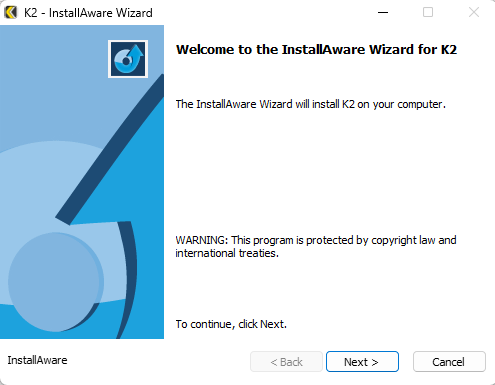


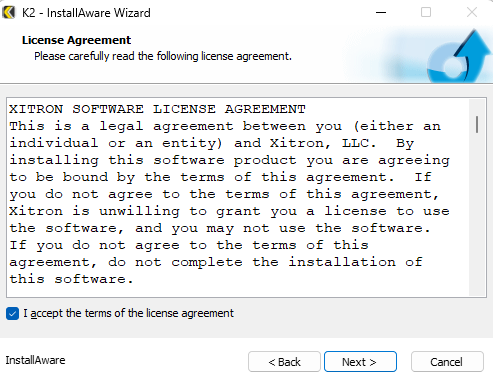
Step 2: License Agreement

  1. Select I accept the terms of the license agreement.
  2. Click Next.


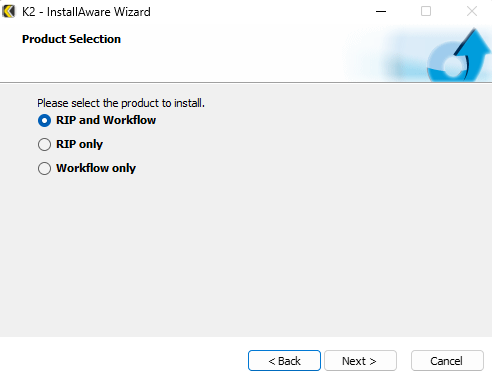
Step 3: Product Selection

To install the Server, RIP, and Software Client, select:

  • RIP and Workflow (This is the standard K2 installation)

To install only the RIP engine, select:

  • RIP only

To install only the workflow and server components (without a RIP), select:

  • Workflow only

Click Next.


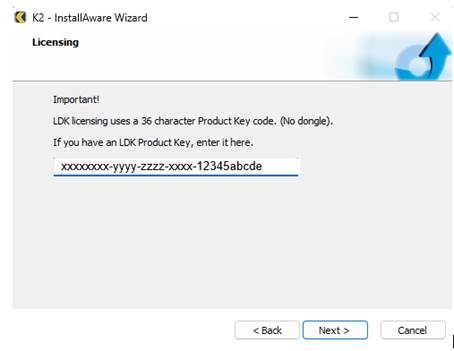
Step 4: Licensing

  1. Enter the 36-character Product Key in the provided field.
  2. Click Next.


Step 5: Destination Folder

Verify that the installation path is set to: 

C:\K2

If correct, click Next.  (Do not install to a network drive or to a removable disk.)
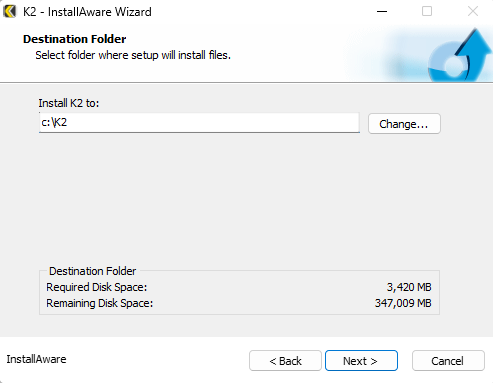


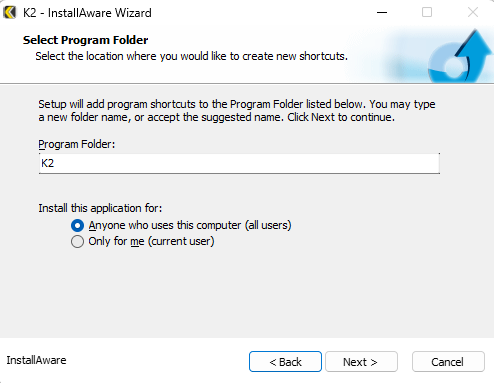
Step 6: Select Program Folder

  1. Accept the default Program Folder name: K2.
  2. Under Install this application for: ensure that
    Anyone who uses this computer (all users) is selected.
  3. Click Next.


Step 7: Configuration Initialization

Dialog: Completing the InstallAware Wizard for K2
Click Next to begin configuring K2 on the local system.
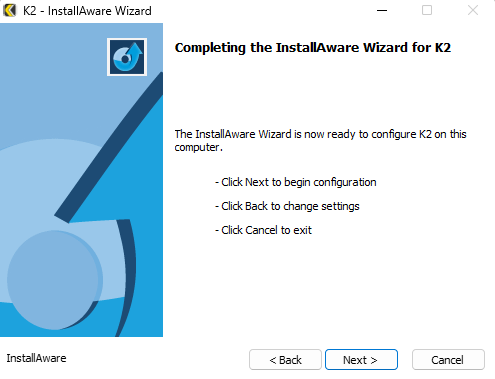
 

  • It is critically important that the Rip Manager server dongle is plugged in and seen by the system to ensure the workflow components are licensed properly.
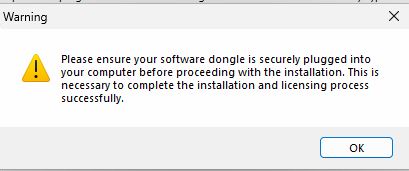


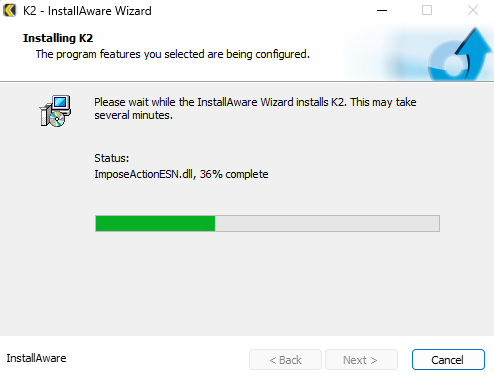
Step 8: Installing K2

Allow the installer to complete the installation process.
 This step will take several minutes.


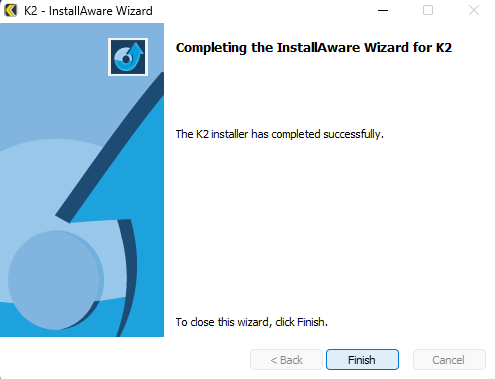
Step 9: Installation Complete

Dialog: Completing the InstallAware Wizard for K2
Click Finish to close the installer.


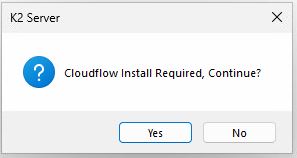
CloudFlow Installation

  1. After installation completes, launch the K2 Server.
  2. When prompted to install CloudFlow, click Yes.
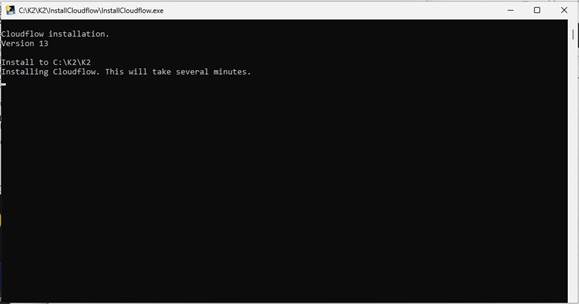
CloudFlow Installation Process

  • A command-prompt–style window will appear, displaying real-time installation progress.
  • This process may take several minutes.

Important:
 Do not close this window. Closing it during installation will result in a failed CloudFlow installation.


Verifying CloudFlow Installation

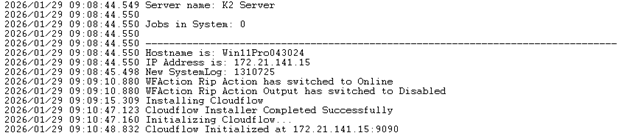
Open and review the Server Log to confirm successful installation and initialization.

A successful installation will include log entries similar to the following:

Installing CloudFlow

CloudFlow Installer Completed Successfully

Initializing CloudFlow

CloudFlow Initialized at <local PC static IP address>:9090


(Note: 9090 is the default port used by CloudFlow.)


Now run the Impostrip installer and install it at the default location.  Here are instructions. 


 ________________________________________________

- More documentation about K2